
2026 America Cost of Living
2026-10-05
Xpatulator’s America cost of living rankings as at 1 October 2026 place Manhattan 1st, San Jose 2nd and San Francisco 3rd, followed by New York City, Boston, Honolulu and Seattle. The top rankings are largely unchanged from July, although Nassau rises 1 place to 15th and Oakland declines 1 place to 16th. Major United States cities remain expensive through housing, healthcare, transport and labour intensive services, while Caribbean locations face additional costs from imported goods, freight and small market scale. Because most top locations either use the United States dollar or maintain fixed exchange rates against it, local price changes have been more important than currency movements. The rankings underline the importance of comparing salary purchasing power rather than nominal salary when considering an international move.
Xpatulator’s America cost of living rankings as at 1 October 2026 place Manhattan 1st with a weighted Cost of Living Index of 115.6, followed by San Jose at 114.1 and San Francisco at 112.8. New York City, which provides the benchmark of 100, ranks 4th. Boston follows at 99.9, Honolulu at 98.6 and Seattle at 98.4. The top seven positions are unchanged from the 1 July ranking.
Xpatulator compares 13 expenditure baskets weighted according to spending patterns typical of international professionals and managers. Household accommodation carries the largest weighting at 30 per cent, followed by transport at 18 per cent and groceries at 16.5 per cent. The Cost of Living Index therefore measures the cost of maintaining a comparable expatriate spending pattern rather than general consumer prices alone.
Manhattan remains 1st, with accommodation, personal care and miscellaneous expenditure contributing strongly to its high cost. Housing remains a particular constraint. Manhattan median rent reached a record 5,295 United States dollars a month in June and remained at that level in July, around 6 per cent higher than a year earlier. Brooklyn, ranked 14th at 91.6, also experienced record rents, while Queens ranks 20th at 86.5, demonstrating the considerable cost differences within the same metropolitan area.
San Jose remains 2nd and San Francisco 3rd. Healthcare, personal care, household goods and transport are particularly expensive in the Xpatulator baskets. San Jose housing costs have also continued to rise, with median rents in August almost 10 per cent higher than a year earlier. San Francisco continues to face strong housing demand associated with its technology economy, including renewed demand linked to artificial intelligence businesses. Oakland, where healthcare and transport are prominent cost pressures, declines 1 place to 16th.
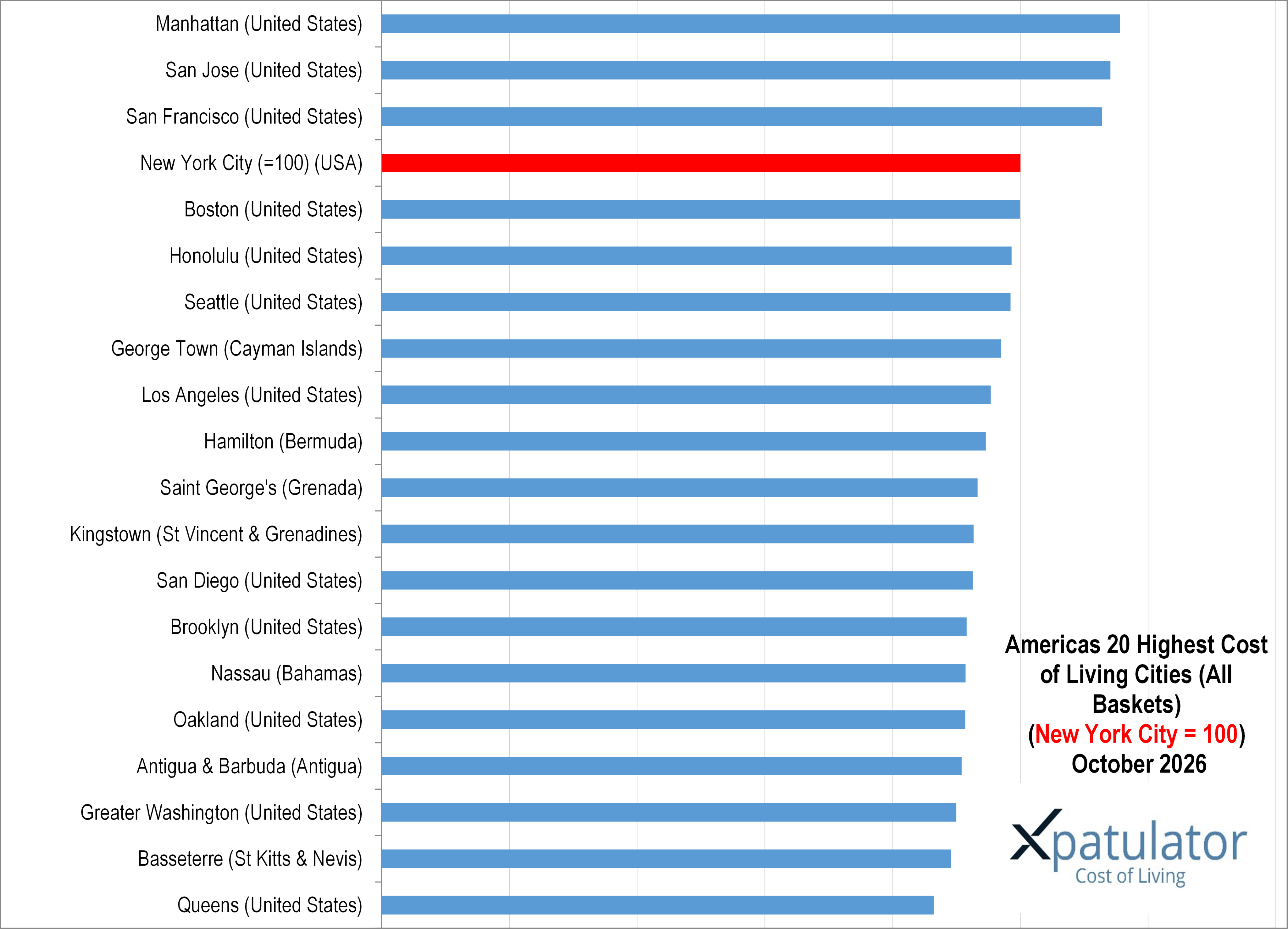
Boston at 99.9 remains 5th, with healthcare and education among its highest relative costs. Honolulu remains 6th at 98.6, where geographical isolation raises the cost of groceries, furniture, appliances and other goods that must be transported over long distances. Seattle remains 7th at 98.4, with healthcare, transport and education particularly important for an international professional household.
George Town in the Cayman Islands remains 8th at 97.0. Communication, transport, clothing and groceries are well above the New York City benchmark. Cayman Islands consumer inflation was 2.8 per cent in the first quarter of 2026, including a 17 per cent increase in communication prices and increases in household equipment, accommodation services and education.
Los Angeles remains 9th at 95.4, with healthcare, education and transport contributing to its cost, while Hamilton in Bermuda remains 10th at 94.6. Bermuda’s April inflation rate was 2.5 per cent, with transport and foreign travel increasing 5.2 per cent and food 4.0 per cent over the year. These categories are particularly relevant to an island economy where many goods are imported.
Saint George’s in Grenada ranks 11th at 93.3 and Kingstown in Saint Vincent and the Grenadines 12th at 92.7. Transport is a significant cost in both. San Diego remains 13th at 92.6, reflecting relatively high transport, healthcare and communication costs. Nassau rises 1 place to 15th at 91.4, overtaking Oakland. Communication and groceries are particularly expensive in Nassau, while Bahamian consumer inflation was 2.7 per cent in February 2026.
Saint John’s in Antigua and Barbuda remains 17th at 90.8, Greater Washington 18th at 89.9 and Basseterre in Saint Kitts and Nevis 19th at 89.1. Communication, transport and imported groceries feature prominently in the Caribbean locations, while Greater Washington has comparatively high international education and communication costs.
Exchange rates have had less influence on the top America rankings than they have in many other regions. Most leading locations are in the United States and therefore already use the United States dollar. The Cayman Islands dollar is fixed at 1.20 United States dollars, Bermuda and the Bahamas maintain parity with the United States dollar, and the Eastern Caribbean dollar used in Grenada, Saint Vincent and the Grenadines, Antigua and Barbuda, and Saint Kitts and Nevis is fixed at 2.70 to one United States dollar. Consequently, changes in local prices, imports, freight and housing matter more than currency fluctuations for most of the top 20.
Inflation is nevertheless exerting renewed pressure. United States consumer prices were 3.4 per cent higher in August than a year earlier. Energy prices rose 16.3 per cent, while shelter increased 3.0 per cent. Xpatulator’s international inflation analysis dated 5 October 2026 also identifies energy as an important global risk, particularly for transport, freight and import dependent economies.
Weather exposure is another consideration for Caribbean and coastal assignments. Atlantic hurricane risk can interrupt transport, raise insurance costs and disrupt energy and goods supply. Hurricane Isaias, the first hurricane of the 2026 Atlantic season, was disrupting Gulf of Mexico energy production in early October, illustrating how weather can feed through to fuel and logistics costs even beyond the immediate storm area.
For expatriates and global mobility specialists, the central issue is salary purchasing power rather than nominal salary. A higher offer can still leave an employee worse off if housing, healthcare, transport, schooling and groceries absorb substantially more income in the host location. Xpatulator’s Salary Purchasing Power Parity Calculator estimates the equivalent salary required in the host location after adjusting for cost of living differences, allowing an international offer to be assessed on purchasing power rather than salary alone.
Use Xpatulator’s Cost of Living Calculators and Tools to compare home and host locations, understand the effect on salary purchasing power, and determine the salary, allowances and international assignment package required to maintain a comparable standard of living.