
2026 City Cost of Living - Top 20 Most Expensive Cities in the World
2026-10-05
Xpatulator’s global city cost of living ranking as at 1 October 2026 places Monaco 1st, Hong Kong, China 2nd, Singapore 3rd, Manhattan 4th and Zurich 5th. Singapore and Manhattan each rise 1 place, while Zurich declines 2 places. Further down the top 20, New York City, Boston, Honolulu, Seattle, Shanghai and George Town each rise 3 places, Los Angeles rises 4 places, while Wellington declines 6 places and Copenhagen declines 4. Housing remains the dominant pressure in Monaco and Hong Kong, while healthcare, transport, services, education and imported goods drive costs elsewhere. Currency movements, inflation and higher global energy and freight costs continue to influence expatriate purchasing power.
Xpatulator’s global city cost of living ranking as at 1 October 2026 places Monaco 1st with a weighted Cost of Living Index of 139.8, followed by Hong Kong, China at 119.5. Singapore rises 1 place to 3rd at 116.7 and Manhattan rises 1 place to 4th at 115.6, while Zurich declines 2 places to 5th at 115.5. San Jose remains 6th at 114.1, San Francisco 7th at 112.8, Geneva 8th at 107.5, Oslo 9th at 105.4 and Sydney 10th at 102.5.
New York City is the benchmark location and is set at 100. Because 10 selected locations are more expensive, it ranks 11th. Boston rises 3 places to 12th at 99.9, London declines 2 places to 13th at 99.5, Honolulu rises 3 places to 14th at 98.6 and Seattle rises 3 places to 15th at 98.4. Copenhagen declines 4 places to 16th at 98.1, Shanghai rises 3 places to 17th at 97.5, George Town rises 3 places to 18th at 97.0, Wellington declines 6 places to 19th at 96.7 and Los Angeles rises 4 places to 20th at 95.4.
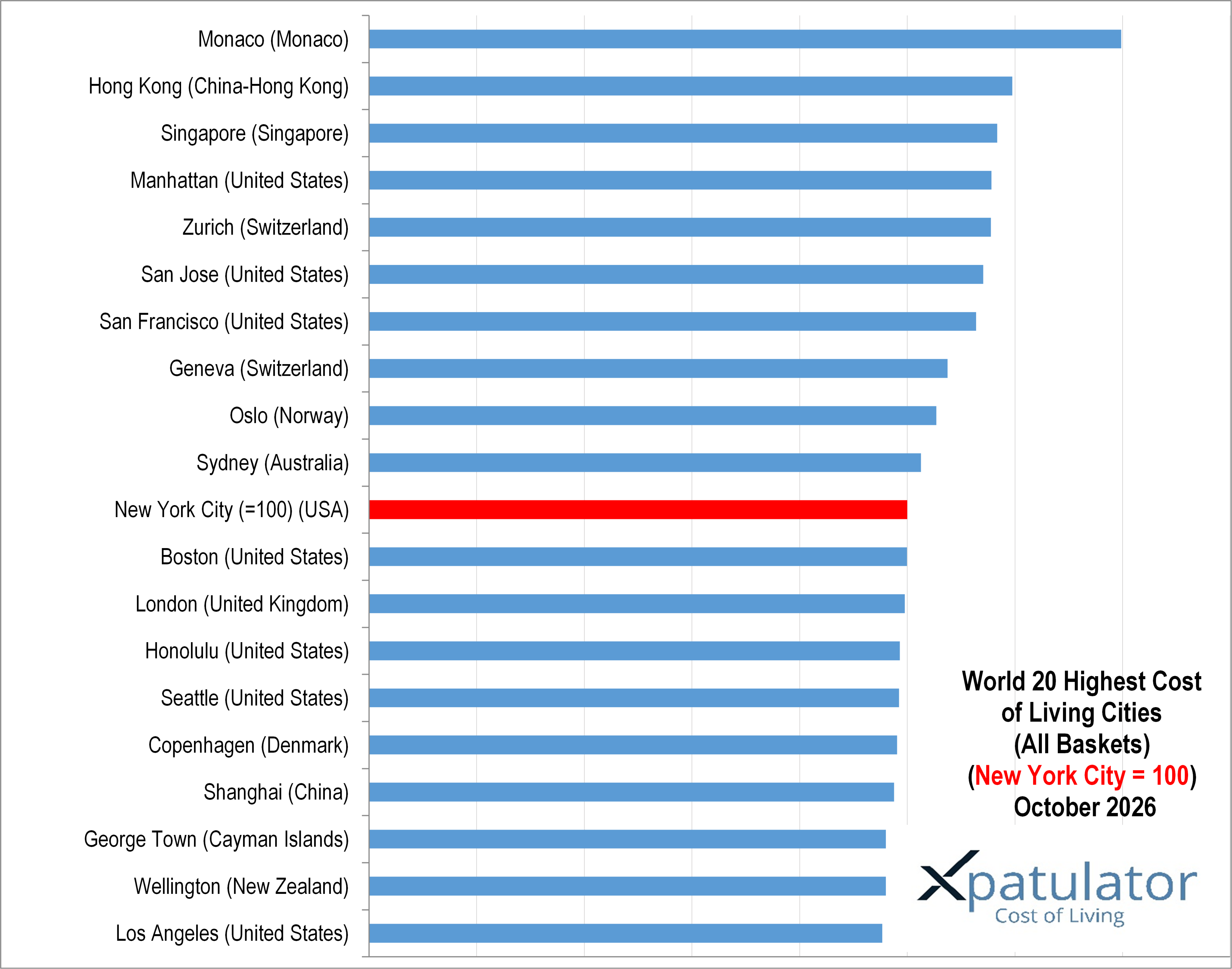
The ranking includes locations classified as City and City Country State. Xpatulator compares 13 expenditure baskets weighted according to typical international professional and manager spending patterns. Accommodation carries the largest weighting at 30 per cent, followed by transport at 18 per cent and groceries at 16.5 per cent. The result therefore measures the relative cost of maintaining an expatriate standard of living rather than general consumer prices alone.
Monaco’s 1st place is primarily a housing story. Its accommodation index is 210.1, while recreation and culture, clothing, restaurants and transport are also well above the New York City benchmark. Monaco Statistics data for 2025 put the estimated residential transaction price at about 57,569 euros per square metre, reflecting the effect of limited land and sustained international demand. Hong Kong, China remains 2nd, with accommodation at 179.6. Strong financial market activity and renewed recruitment have also attracted international professionals back to the city during 2026, supporting demand in a market where suitable housing remains constrained.
Singapore’s high cost is spread across personal care, alcohol and tobacco, transport, accommodation and clothing. Inflation was 2.3 per cent in August, with increases in airfares, point to point transport, clothing, personal care and food. Manhattan combines expensive accommodation with particularly high personal care and miscellaneous costs. Its median rent reached a record 5,295 United States dollars a month in June and remained there in July.
Zurich and Geneva remain expensive through transport, clothing, restaurants and personal services. Housing supply is also exceptionally tight: Zurich had a residential vacancy rate of 0.11 per cent in June 2026 and Geneva 0.31 per cent. San Jose and San Francisco are driven more strongly by healthcare, personal care, household goods, education and transport, against the background of high professional incomes and technology sector demand. Oslo has particularly high household goods, miscellaneous, transport and personal care costs.
Sydney remains 10th despite its index falling from 106.4 in July to 102.5. Household goods, transport, clothing and miscellaneous expenditure are important, while Australian inflation reached 4.0 per cent in August and housing prices within the national Consumer Price Index rose 5.7 per cent.
Boston’s main pressures are healthcare and education. London remains costly through transport, clothing, services and housing, with average private rent reaching 2,332 pounds sterling a month in August, 3.5 per cent higher than a year earlier.
Honolulu’s household goods and groceries are expensive partly because of the cost of supplying an island economy. Seattle’s healthcare, transport and education costs remain high. Copenhagen is particularly expensive for transport and paid services.
Shanghai’s main expatriate pressures are accommodation and international education, while George Town combines high communication, transport, clothing and grocery costs. Cayman Islands inflation was 2.8 per cent in the first quarter of 2026, including a 17 per cent increase in communication prices.
Wellington has high household goods, transport and miscellaneous costs, while Los Angeles is relatively expensive for healthcare, education, transport and communication.
Exchange rates have contributed to the reshuffling since last year. At the end of September 2026, the euro, Swiss franc, pound sterling and New Zealand dollar were weaker against the United States dollar than at the end of September 2025, while the Australian dollar, Singapore dollar, Chinese yuan and Norwegian krone were stronger. A weaker host currency generally reduces costs when translated into United States dollars, helping explain some of the relative declines in Zurich, London, Copenhagen and Wellington. Conversely, a stronger host currency can increase international costs, although local basket prices may offset or outweigh that effect. Hong Kong’s currency remains within its long standing linked band of 7.75 to 7.85 to one United States dollar, limiting direct foreign exchange volatility.
Inflation remains uneven. Xpatulator’s international inflation analysis dated 5 October 2026 reports higher energy and food pressures, euro area inflation of 3.8 per cent in September, comparatively subdued inflation in China and continuing inflation pressure in the United States. Oil above 100 United States dollars per barrel is raising aviation, freight and distribution costs. Shipping and insurance costs for energy flows have also risen sharply amid geopolitical disruption, increasing the risk of further cost pressure for import dependent locations such as Singapore, Honolulu, George Town and Wellington.
For expatriates and global mobility specialists, the relevant comparison is salary purchasing power rather than nominal salary. An apparently attractive offer can still reduce disposable income if accommodation, healthcare, transport, education and other recurring costs absorb more salary than at home. Xpatulator’s Salary Purchasing Power Parity Calculator estimates the equivalent host salary required after adjusting for cost of living differences, allowing an international offer to be compared on purchasing power rather than headline pay.
Founded in 2007, Xpatulator organises cost of living, exchange rate and hardship data for international relocation decisions. Use Xpatulator’s Cost of Living Calculators and Tools to compare home and host locations, assess salary purchasing power and establish the salary, allowances and assignment package required to maintain a comparable standard of living.